
Best pacifiers for newborns: how to find the one your baby loves
By Myranda Duma, Founder of Tiny Trials
If you have ever offered your newborn a pacifier six times and watched them push it straight back out, you are not doing anything wrong, and your baby is not being difficult. I started Tiny Trials because this exact kind of small decision, multiplied across everything you have to figure out in the first year, is genuinely exhausting. So here is the honest, no-guesswork version of how to choose a pacifier for a newborn, and how to find the one your baby actually settles with.
The short version: there is no single best pacifier. There is only the one that suits your baby, and the way you find it is by comparing a few good ones rather than betting on a single pack.
Why your baby keeps spitting it out
Most of the time it is not rejection, it is reflex. Newborns are born with a tongue-thrust (or extrusion) reflex that pushes objects out of the mouth. It is a normal, protective reflex that helps babies feed safely, and it usually eases over the first few months. So in the early weeks, a baby pushing the pacifier out is often just their reflex doing its job, not a verdict on the pacifier.
A small thing that helps: offer it when your baby is calm and content, ideally after a feed, not mid-cry or when they are hungry. Gently touch it to the roof of the mouth to invite the natural sucking reflex, and let them take it rather than pushing it in. If they are not interested, take it away and try again later. Some babies take to one in a day, some need a couple of weeks of low-pressure offers. All of that is normal.
When to introduce a pacifier
If you are breastfeeding, the American Academy of Pediatrics suggests waiting until breastfeeding is well established, at around three to four weeks, before introducing a pacifier, so feeding and your milk supply have time to settle (AAP). If your baby is bottle-fed, there is generally more flexibility on timing. Either way, these are guidelines, not hard rules, so it is worth checking in with your own pediatrician about your baby.
What actually differs between pacifiers
Once you start looking, the choices feel endless, but they really come down to three things.
Nipple shape. The two you will see most are orthodontic (a flatter, angled shape designed to sit against the palate) and rounded (the classic cherry shape). Neither is better for every baby. Plenty of babies happily take one shape and refuse the other, which is the single biggest reason a pacifier gets rejected.
Size and age range. Newborn pacifiers are made smaller and lighter, usually labelled 0 to 3 months or 0 to 6 months. Getting the size right for your baby's age matters more than the brand on the shield.
Material. Silicone is firmer, more durable and holds its shape; latex is softer and more flexible but wears out faster and is not suitable if there is any latex sensitivity in the family. Some babies clearly prefer the feel of one over the other.
Keeping it safe
For newborns, a one-piece design (nothing that can come apart) is the simplest safe choice. Never tie a pacifier around your baby's neck or to a cord, use the size that matches their age, and replace any pacifier that looks worn, sticky or damaged. Give new pacifiers a proper clean before the first use per the pack instructions.
If you are breastfeeding
The common worry is nipple confusion. Once breastfeeding is established, many breastfed babies happily take a pacifier for comfort between feeds. A lighter newborn pacifier with a shape closer to a natural latch is a sensible starting point, and again, having a couple of shapes on hand to compare beats committing to one and hoping.
Why comparing beats guessing
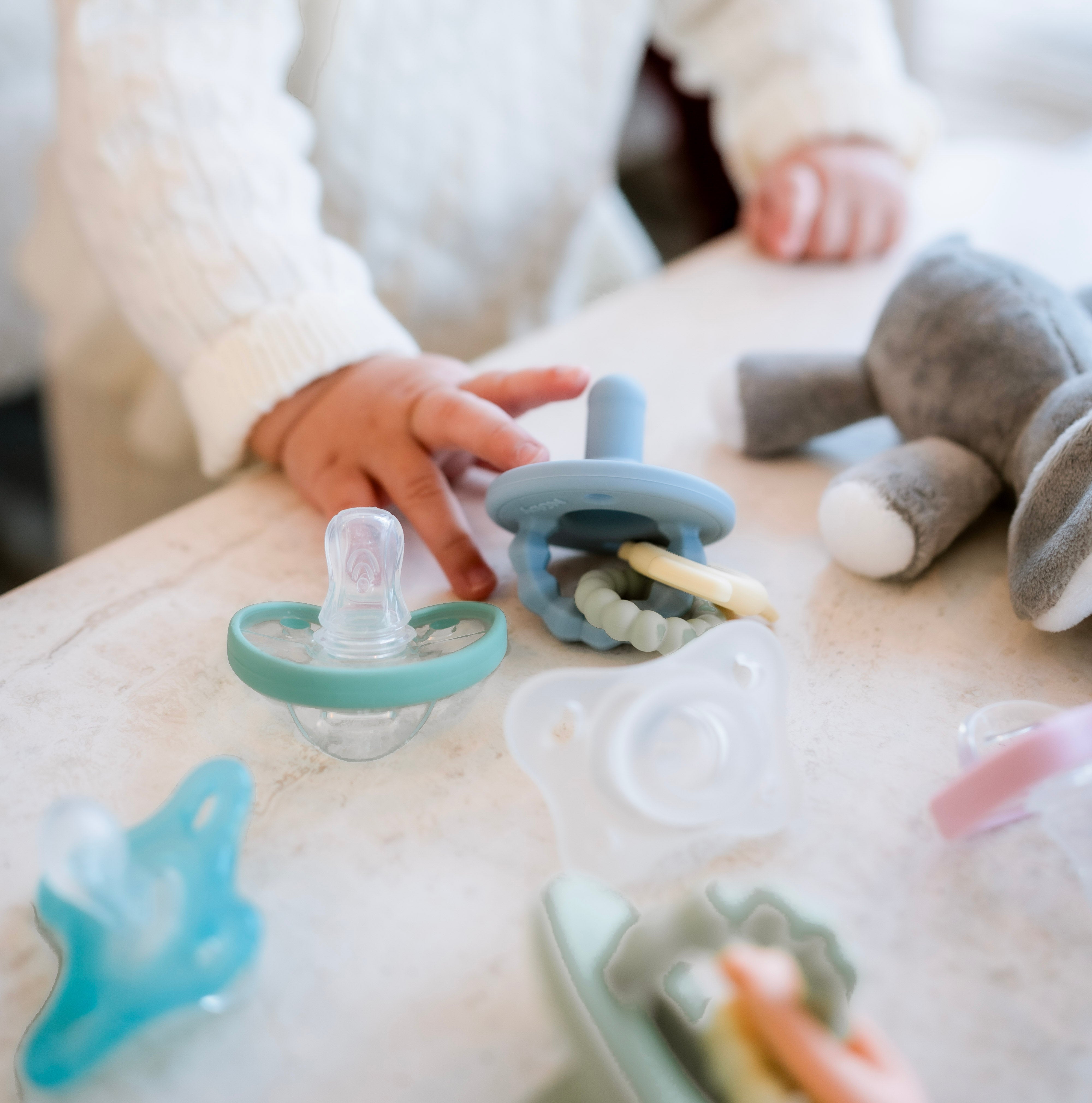
Here is the honest way to do this without a drawer full of rejected pacifiers: try a few trusted brands and shapes side by side and let your baby show you the winner. That is exactly why we put together the Tiny Trials Pacifier Trial Box, a curated set of 9 pacifiers across 6 styles from brands parents trust, plus a clip. You get to compare orthodontic and rounded, different sizes and materials, and keep the ones that work, because every baby and family is different and finding your pacifier shouldn't feel like guesswork.
Explore the Tiny Trials Pacifier Box and take the trial and error out of it.
Related reading: orthodontic vs round pacifiers, and what to do when your baby won't take a pacifier.
Sources: American Academy of Pediatrics, guidance on pacifier use and breastfeeding (aap.org). This article is general information, not medical advice; check with your pediatrician about your baby.

Myranda Duma | Founder, Tiny Trials
Myranda is a mom of two who knows the invisible load parents carry, how quickly small decisions add up, and how often you are asked to commit to a product without knowing what will actually work. She built Tiny Trials from that lived experience, so families can discover what suits their baby without the guesswork. One tiny trial at a time.